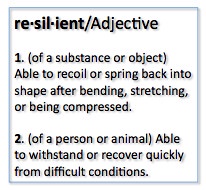
There is huge interest at the moment in the area of the development of personal resilience within both academic research and from the general public. Of course, if you are lucky enough to never experience any sort of adversity, you won’t know how resilient you are. It’s only when we are faced with obstacles, stress, and other environmental threats that resilience, or the lack of it, emerges: Do you succumb or do you surmount? Very often personal resilience emerges from both the management of threats from the environment, a certain degree of luck and personal connectivity that shields from the worst that life can throw at us. So what do we know about the characteristics and practices of resilient people and can such resilience be developed? Research shows us that resilient people tended to “meet the world on their own terms”. They are autonomous and independent, seek out new experiences, and have a “positive social orientation”. One of the first people to use the term resilience was Norman Garmezy, a developmental psychologist and clinician at the University of Minnesota. Garmezy, like many psychologists studied the reactions of children to the circumstances in which they found themselves. But what he found interesting was not children who had problems or who were ‘acting out’ in school, but those kids who should have been exhibiting problems but weren’t. Kids whose home life and personal circumstances put them at high risk, but who were functioning well – and sometimes excelling. Garmezy looked for elements of strength, rather than weakness. Subsequent research has identified a number of ‘protective’ factors that allow children and adults alike to overcome the obstacles that life and work presents. Things such as a personal feeling of autonomy, an understanding of ability to act independently rather than ‘react’ to their environment and an ability to control emotions and impulses are shown to be key to bouncing back from what can feel like mountainous difficulties. Those with high levels of resilience tend to ‘frame’ challenges as opportunities and perceive difficult experiences as having a dimension which could lead to personal, psychological or sometimes spiritual growth. The other interesting finding of much of this research indicates that we can build, but also weaken our own resilience and ability to move forward in times of difficulty[1].
So what sort of strategies can we put in place for ourselves are our colleagues that allow us to become more resilient personally and professionally? It’s useful to ask ourselves how we tend to perceive events, difficulties or circumstances outside our own control? This is ‘framing’: a cognitive mechanism which can illicit negative feedback or a positive reimagining. Actively understanding that we have more control than we think gives us back mental space which can be liberating. Other well know strategies like mindfulness – ‘staying in the present moment’ and compartmentalising challenges are also popular and useful. One active approach is the decision to observe a situation rather than react to it. The next time you are faced with a workplace challenge or a difficult meeting, focus on observing what is actually happening rather than your own emotional or psychological reaction. Be actively aware of the internal story you are telling yourself. We can significantly increase (and decrease) our personal resilience by managing the internal messages we give ourselves.
And how do we develop resilience in others who we might have some responsibility for? Perhaps the biggest lesson from the collected research on resilience is the importance and the possibility of building what researchers call ‘a scaffolding of support’. This doesn’t mean ‘mollycoddling’ or lifting difficulties of others. It means actively modelling not just success, but the way to success. One fascinating study of US marines who had failed basic training (a public and humiliating experience) took those individuals through that training again, but this time buddying them with a partner every (literal) step of the way. Those marines transformed public failure into public success – but not on their own. They still did the work, but with a personal and organisationally scaffolding of support. Turning around what feels like a failure is possible – for both ourselves and others. Interestingly those marines turned out to be more successful as organisational members after their experiences. Resilience is built from adversity, but it also requires those around us to reach out a hand.
#resilience #personaldevelopment #adversity
 Joanne Murphy
Leave a comment