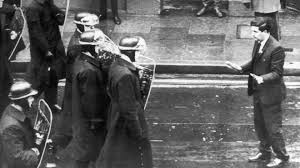
It’s been two weeks now since the death of John Hume. His long illness and quiet retreat from the politics of these islands has been replaced with an outpouring of grief and gratitude – not least in Derry where he was so well known and deeply missed. Now that we have moved from the twilight time of his illness into an era which can more comfortably look at his legacy, where do the values he espoused sit and what relevance do his oft repeated words have for an island which is out of conflict but not yet at peace?
On the morning of John’s death I was privileged to be asked to contribute a few words to a collection of academic tributes in that day’s Irish Times. Whether it was the proximity of mortality in our Covid altered world, or where the request itself came from, my thoughts turned to another piece, written by an Irish Times journalist before his own career with that paper. That journalist is the Irish Times Belfast correspondent Gerry Moriarty and the piece I refer to relates to his experiences on the 27th of August, 1979 when Moriarty was a young reporter with the Donegal Democrat. This was the day the IRA blew up the boat of Lord Mountbatten, and murdered him, his mother, his 14 year old grandson and a local boy – 15 year old Paul Maxwell[1]. What I will always remember about Moriarty’s recounting of these events is his searing reiteration of the words of Maxwell’s father. Moriarty recalls (and I hope he will not mind me quoting directly) “there on the wall I noticed a bronzed, bearded, muscular man wearing only shorts and sandals pacing up and down, beside himself with grief. It was John Maxwell (then 43) from Enniskillen, Co Fermanagh, father of the fourth fatality of that terrible day, 15-year-old Paul Maxwell, who while holidaying in Mullaghmore made friends with the Mountbatten party and was invited on the boat trip that day, August, 27th, 1979. As the boat berthed beneath the harbour wall John Maxwell, a Protestant of unionist background – but who then as now despairs of nationalisms, whether unionist nationalism or Irish nationalism – looked down on the dead body of his beloved son and cried repeatedly: “Look what you’ve done to him, look what you’ve done to him. I’m an Irishman, he’s an Irishman, is this the sort of Ireland you want?“.
‘Is this the sort of Ireland you want?’. These are words not easy to forget. Of course, this is above all the retelling of a great tragedy: a parent’s words of bottomless pain and despair. But it struck me then and has stayed with me since as also the most profound distillation of a much bigger question which we must all answer about the nature of the Ireland we are contributing to and what this Ireland should be. Now, with Hume’s death that question is being posed again. Many of Hume’s words have been quoted over the past days. In general these relate to reconciliation, his determination to halt violence and the sacrifice of reputation and peace of mind to pursue that objective. It has been remembered that the campaign of vitriol mounted against him at the time of his engagement with Gerry Adam’s was almost unique in its deliberate and calculated viciousness – and that is saying something. It is only now with his death that the current editor of the Sunday Independent has acknowledged that the attacks his paper spearheaded ‘have not aged well’. But what is sometimes obscured in the urgency of Hume’s action against violence was his intertwined challenge about the nature of Irish identity and what Irishness should mean, even in the worst of times. In this he argued that it was the responsibility of Irish nationalism to recognise and embrace unionists and to reject the default exclusionist position of both political traditions. Peter McLoughlin, in his interesting and reflective book ‘John Hume and the Revision of Irish nationalism’ quotes Hume on this issue in 1975 – during some of the worst days of the troubles. Talking of the Catholic and nationalist community and the history of nationalism in Irish state, Hume argues “we have been handed down a set of political dogma that has served us badly…We have been given an exclusivist notion of Ireland which excludes and wants to exclude the million people in the Northern part of Ireland who have every right to be there. The exclusivism, that undefined Irishness to which if you do not ascribe you do not belong, is the same thing again – ascendency of one tradition over another. But we know for certain that if we do we shall fail, because it too leads only to conflict and to the grave” (p72-73). The grave Hume talked about was precisely the vista confronted by the father of 15 year old Paul Maxwell just four years later. Now, more than forty years after these events we are still challenged by the fundamental nature of these questions, the need to share this island and to respect the integrity of the increasingly diverse traditions who belong to it.
The period of reflection which has followed the death of Hume should allow us to properly reflect for the first time on the depth and diversity of his contribution. He will be remembered as a patriot and a peacemaker, but it should not be forgotten that beyond that he was an internationalist, European to his heart, and an Irishman who understood and articulated the totality of responsibilities, complexities and duties of Irish identity. Most of all he should be remembered as a leader whose ‘armoured intellect’[2] created the possibility of a path to a truly New Ireland, and one which owes so much to his vision.
[1] It should be noted that on the same day, the IRA killed 18 British soldiers in Narrow Water in Warrenpoint, Co Down.
[2] See Brendan O’Leary’s Irish Times contribution 4th August 2020
 Joanne Murphy
Leave a comment