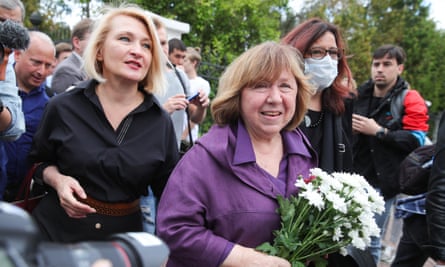
Like many people, I have looked on in horror at the developing situation in Belarus and the bravery shown by its people in the face of unspeakable brutality. As someone who is interested in leadership, I’m frequently asked to recommend books or articles which allow people to short-circuit their study of a huge and complex area and get to the heart of the concept. One of the books I recommend most often is Keith Grint’s brilliant ‘The Arts of Leadership‘. It’s a great piece of work and written with wonderful immediacy and verve – as you would expect from someone who many regard as the outstanding leadership thinker of the present day. I’ve always felt the book has resonance beyond just (!) its brilliant analysis leadership. It also provides a glimpse of what leadership can be – and how it embodies a heroism and an understanding of humanity beyond the everyday. Anyone that has read the book or has it on their shelf knows that it contains an intriguing and enigmatic dedication – To ‘an unknown woman in Minsk‘. This itself gives us something to think about before we even get to the content. The women is question – if it is the story generally associated with Grint’s epithet – is thought to be Masha Bruskina – a Jewish partisan who was hanged by the SS alongside two named men on Sunday, October 26, 1941, in front of Minsk Kristall. She was known at the time and photos exist of her death and her refusal to comply with Nazi orders to face the crowd. However, a post war memorial simply referred to her as ‘unknown’. An unnamed time traveller to bravery. Only in 2009 was she given back her identity on a plaque beside the original monument. Her original exclusion seems to have been because of her Jewish religion – an unwelcome detail in a post war Soviet Union. I thought about this book, and this extraordinarily brave woman when I saw recent TV pictures of democratic protests in Minsk. Again, what was striking was the leadership of women within them. While many of those involved have now been arrested or deported, one prominent campaigner for democracy remains. Her name is Svetlana Alexievich. She is better known for her work as a Nobel prize winning author. The extraordinary cannon which she has produced and which I discovered myself just a few years ago, delves into and illuminates the most dreadful of times – the experience of children as witnesses to violent conflict, the role of women as combatants in the ‘great patriotic war’, the experiences of those who saw first hand the real and metaphorical fallout of the Chernobyl nuclear disaster. She writes beautifully but perhaps what is most captivating about her narrative is that the voices coming off the page are those of the people she has interviewed themselves. She has been able to capture the immediacy and the essence of their experiences and to give them space to relate those truths in a way that is both authentic and cathartic. Now Svetlana Alexievich herself is the centre of the story. International diplomats stay in her apartment on a rota basis to offer some protection against arrest. The momentous events of which she has written so evocatively, surround her now and she has become a symbol of democracy and the freedom to think, to write and to speak as you wish. We must wait and see what happen’s next. Once again, the women of Minsk – known and unknown – stand as a bulwark against authoritarianism and abuse.
 Joanne Murphy
Leave a comment