Like many people at the moment, I’m mesmerised and horrified in equal measure by American politics and the coming presidential election. Every day seems to bring new revelations, accusations and ‘leaks’ in what has got to be the most divisive and important election of our lifetimes. The startling revelation of recent weeks has been the alleged statements of President Trump in relation to US troops and veterans – an issue which goes to the heart of American identity, loyalty and history. The idea that an American president would articulate a view that US veterans and troops killed in combat are “losers” and “suckers” seems both extraordinary and yet horribly credible. These accusations are strongly denied by Trump and his administration, but the taint remains. How seriously they are taken by the veteran community and those still serving appears contested and the impact of such accusations remains to be seen. However, what these events have done is spark a fascinating retrospective on how previous Presidents and administrations have managed and led through the most extreme of circumstances. I was struck recently by a thread on twitter which took an early iteration of this debate and followed through on Presidential reflections on perhaps the most emblematic of that sacrifice – the events of D Day and after. This thread consisted of a number of narratives focused on the differing perspectives of American Presidents and those around them in relation to the reality of commemoration, of loss and sacrifice during conflict and war. The first of these is the searing experience of Dwight Eisenhower, American President and before that, the supreme commander on D-Day. Unable to speak and covering his face with a napkin, Eisenhower’s understanding of the horror and sacrifice was articulated in an unmissable way by his very inability to put into words what his orders has meant. If you haven’t seen the New York Times article (tagged) which revisits this undeniably painful moment, then I urge you to read it. I would also suggest that you follow it with a read of Eisenhower’s own remarks on the tenth anniversary of the D-Day landings – an understated, inclusive and forward looking piece of writing. I have reproduced it below.
From the American Presidency Project:
Statement by the President on the 10th Anniversary of the Landing in Normandy.
June 6, 1954
This day is the tenth anniversary of the landing of the Allied Expeditionary Force in Normandy. That combined land-sea-air operation was made possible by the joint labors of cooperating nations. It depended for its success upon the skill, determination and self-sacrifice of men from several lands. It set in motion a chain of events which affected the history of the entire world.
Despite the losses and suffering involved in that human effort, and in the epic conflict of which it was a part, we today find in those experiences reasons for hope and inspiration. They remind us particularly of the accomplishments attainable through close cooperation and friendship among free peoples striving toward a common goal. Some of my most cherished memories of that campaign are those of friendly cooperation with such distinguished military leaders of foreign nations as Field Marshal Montgomery, Admiral Ramsay, Marshal of the Royal Air Force Tedder, Marshal de Lattre de Tassigny, Marshal Juin and Marshal; Leclerc. I recall my pleasant association with the outstanding Soviet soldier, Marshal Zhukov, and the victorious meeting at the Elbe of the Armies of the West and of the East.
These lessons of unity and cooperation have by no means been lost in the trying period of reconstruction since the fighting stopped. Rather, we see peoples, once bitter enemies, burying their antagonisms and joining together to meet the problems of the postwar world. If all those nations which were members of the Grand Alliance have not maintained in time of peace the spirit of that wartime union, if some of the peoples who were our comrades-in-arms have been kept apart from us, that is cause for profound regret, but not for despair. The courage, devotion and faith which brought us through the perils of war will inevitably bring us success in our unremitting search for peace, security and freedom.
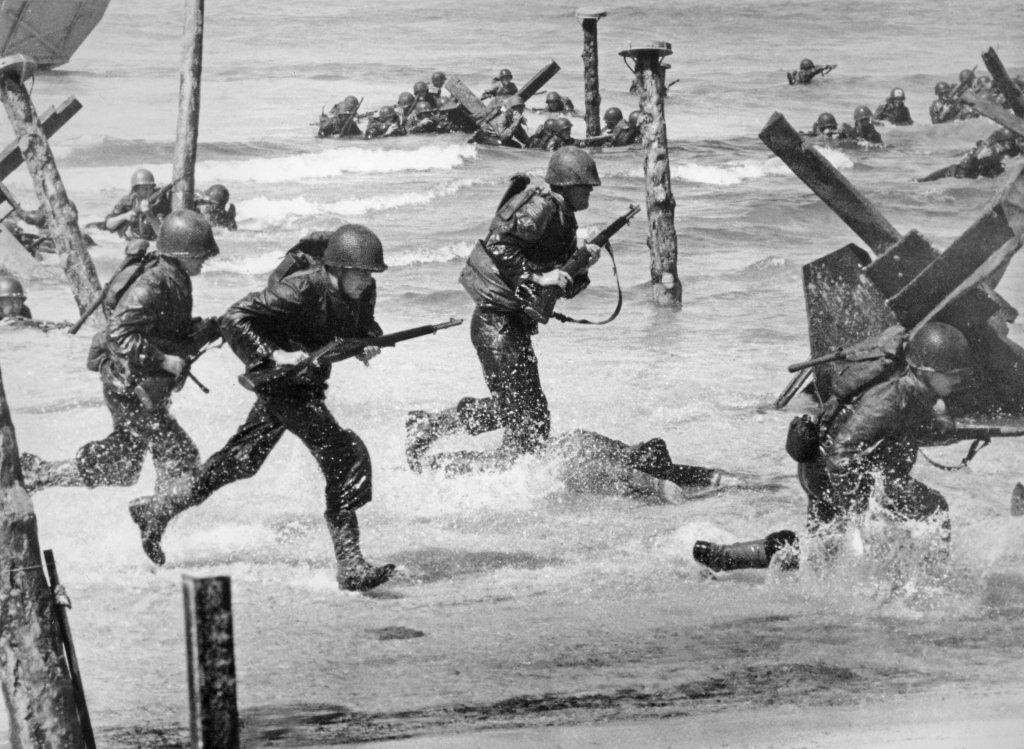
But the twitter thread where I came across these moving narratives didn’t stop there. It moved on to a discussion of the famous eulogy of President Reagan on the 40th anniversary in 1984, at the U.S. Ranger Monument. Seated in the front rows as he spoke, were what had become known as the boys of Pointe du Hoc. Halfway between Omaha and Utah beaches, the cliffs of Pointe Du Hoc dominated the skyline. These old men, when young, had scaled the french cliffs under german fire to secure a vital strategic advantage and overpower the german battery located there. Surrounded by them Reagan intoned “Forty summers have passed since the battle that you fought here. You were young the day you took those cliffs; some of you were hardly more than boys.”
It’s a great speech and it relates to a series of events which are nearly unimaginable in their bravery and danger for us watching from the ‘safety’ of 2020. Peggy Noonan reflected on these decades old events in an article for the Wall Street Journal in 2019. She recalled “My friend John Whitehead once told me, in describing that day, of a moment when, as a U.S. Navy ensign, he was piloting his packed landing craft toward Dog Red sector on Omaha Beach. They’d cast off in darkness, and when dawn broke they saw they were in the middle of a magnificent armada. Nearby some light British craft had gone down. Suddenly a landing craft came close by, and an Englishman called out: “I say, fellows, which way to Pointe du Hoc?” Jaunty, as if he were saying “Which way to the cricket match?” On John’s ship they pointed to the right. “Very good,” said the Englishman, who touched his cap and sped on. John remembered the moment with an air of “Life is haphazard, a mess, and you’re in the middle of a great endeavor and it’s haphazard, a mess. But you maintain your composure, keep your spirit. You yell to the Yank, ‘Which way to Pointe du Hoc?’ and you tip your hat and go.’ ” He would think of the Englishman for the rest of his life, and wonder if he’d survived. But of course he survived in John’s memory, then in mine, and now, as you read, in yours”.
These events are huge, both now in our imagination and in history. But around us now are challenges just as important in our time: climate change; covid; a rise of totalitarianism; ‘fake news’, and a shifting of the earth beneath our feet. Perhaps in the midst of all that we can remember that man in a boat, heading for great danger, tipping is hat and asking “which way to Pointe Du Hoc”?
With thanks to @PatrickJMB for twitter tip offs
 Joanne Murphy
Leave a comment