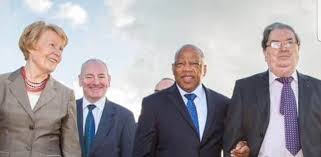
On Tuesday, I have the great privilege of chairing a panel of distinguished researchers and commentators on the leadership legacy of John Hume and John Lewis. The panel is entitled ‘Leadership as Bridgebuilding’ in an attempt to encapsulate the collective and connective aspects of the leadership of both Hume and Lewis. Of course, a theme like this raises many questions, not least the complexity of the interrelationship between the USA and Ireland, the role of emblematic leadership, the centrality of collective action and how to span divides that create solutions to intractable problems. When I think about Hume and Lewis, there is another characteristic that comes to mind, and that is bravery – or to put it another way – the management of fear. I have written about this in my recent book as a characteristic of conflict transformation entrepreneurs, but it feels particularly significant this week during an election which has been shrouded in threats – of a pandemic, of racial injustice and disharmony, of protest and counter protest and to democracy itself.
The success of the self identified ‘Irish’ President elect Joe Biden seems an inflection point in a conflict riven landscape. The emblematic nature of the US Presidency makes it one of those roles which holds within it the hopes and dreams of an untold number of people. By acquiring the title, the President himself takes on a mantle of leadership which, while it comes with an expiry date (looking at you President Trump) it is never fully relinquished. Presidents retain both the symbolism of the title and the soft power of having held the office. This is why much of the debate around this US election has been about ‘character’: a willingness to be and do the right thing, to take responsibility for your actions and the bravery to carry that through. It is not a surprise that in such a charged atmosphere, other leadership figures who have gone before have haunted this campaign like ghosts, their present almost tangible, exhorting a better way. John Lewis was there of course. His extraordinary bravery, manifesting in physical resistance to brutality and political resistance to discrimination, represents a breath taking lifetime of resilience. Lewis’s death during the last months of the Trump presidency, his words of ‘good trouble’, and his encouragement to young people to pick up the torch all occurred against the backdrop of horror and fury at the death of George Floyd. #Icantbreathe became a powerful angry retort to those who believed that the work Lewis had dedicated his life to was done. Another ghost was also present – a once presidential hopeful who did not take the crown – Senator John McCain. While McCain had his detractors, there was no question that at personal and political inflection points his raw bravery could not be called into question. Those final acts – voting and speaking against the worst excesses of Trump – threw the inaction of the republican party into sharp relief. His evocation eight years ago of Obama as an opponent, not an enemy was echoed by Biden as he called for a return to decency and civility in politics. If Lewis represented the soul of the Democrats, McCain was the spectre at the feast for Republicans – a truth which could not be escaped. There can be few too, observing Biden in these months who have not thought to themselves the depths to which he must have had to reach to overcome the deaths of his young wife and child and latterly his son, and the courage it must have taken to continue. This new presidency is seen by many an opportunity to span divides and re-establish tarnished relationships. This week, as the election result began to crystallise and it became clear that Biden was uncatchable, I had a brief conversation with someone who had been active in his campaign. “Thank God for John McCain and John Lewis” was what he said. Leadership as bridge building.
 Joanne Murphy
Leave a reply to JessicaJiggae Cancel reply