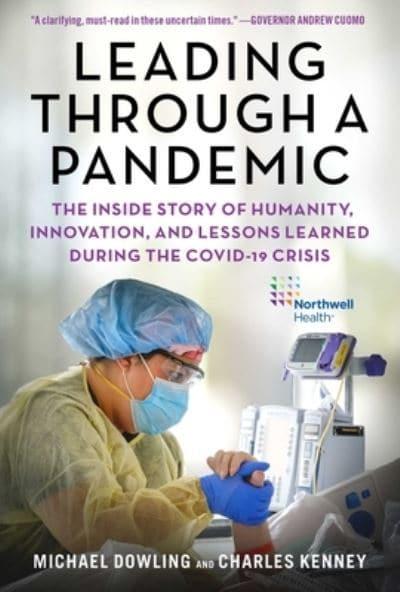
Leading through the Covid 19 pandemic has become a preoccupation for many facing disruption and difficulty at this time. Michael Dowling’s timely new book ‘Leading Through a Pandemic: The Inside Story of Humanity, Innovation, and Lessons Learned During the COVID-19 Crisis’ provides perhaps, the first organisational account of the challenges and struggles of leadership practitioners at this extraordinary time. Dowling is widely regarded as one of the most internationally influential thought leaders on healthcare management and holds honorary doctorates from a number of Universities – including Queen’s. His experience of leading through Covid 19 arises from his role as president and CEO of Northwell Health, where he leads a clinical, academic and research enterprise with a workforce of more than 72,000 and annual revenue of $13.5 billion. Northwell is the largest health care provider and private employer in New York State, caring for more than two million people annually through a network of nearly 800 outpatient facilities, including 220 primary care practices, 52 urgent care centers, home care, rehabilitation and end-of-life programs, and 23 hospitals. With this structure, it was at the centre of the New York pandemic response and Dowling was at the helm during a once in the generation crisis. I was very fortunate this week to be able to offer some closing remarks at the end of Michael Dowling’s guest lecture at QUB – an event facilitated through the Chief Executive’s Club at Queen’s. Michael’s inspirational address reflected on both his own leadership experiences over the past year and some of the lessons for leadership practice more generally. In doing so, it focused on both the human and the technical aspects of the leadership challenge. For example, the last year has starkly illustrated the importance of planning for resilience, preparation for adverse incidents and the need to actively construct both adaquate domestic infrastructure and international early warning systems to allow for the best possible responses to future events. This means, as Michael reflected, cultivating a culture of preparedness, innovation and creativity within local, national and international structures and actively preparing for the worst that can happen. Perhaps the most evocative parts of Michael’s address related to his own personal leadership ethos and approach. He spoke about the centrality of communication as a leadership practice and importance of choosing leaders who are team players and who are interested in building collaborative cultures – not operating solo. Most movingly was is emphasis on what he called ‘walking the wards’ – being present with your colleagues when they were going through the worst of times. This belief that if you put your staff on the front lines, you have to be on the front lines with them, has real resonance for anyone managing or leading over the past year. It also puts leaders and leadership at the very center of human experience and the lived reality of their colleagues lives. In the time of Covid, this means being a witness to both the horrific and the heroic, and cultivating leadership behaviors which are personally trustworthy, accountable and seek to draw people together under a central vision. One of the things that came across most clearly from Michael’s address is his relentless optimism and his counsel that leaders should strive to remain upbeat and optimistic – not only when times are good, but also when times are not so good. He was careful to stress that bad times pass and that this experience of Covid – while dreadful, also has the potential to make us more prepared and better able to deal with the next big challenge. Thanks to Michael we now have the opportunity to understand how these important points reflect not just on individual leaders, but for the collective leadership of our organisations, our communities and our societies going forward.
Michael Dowling’s full address including the Q&A facilitated by Professor Mark Lawler is available here.
 Joanne Murphy
Leave a comment